

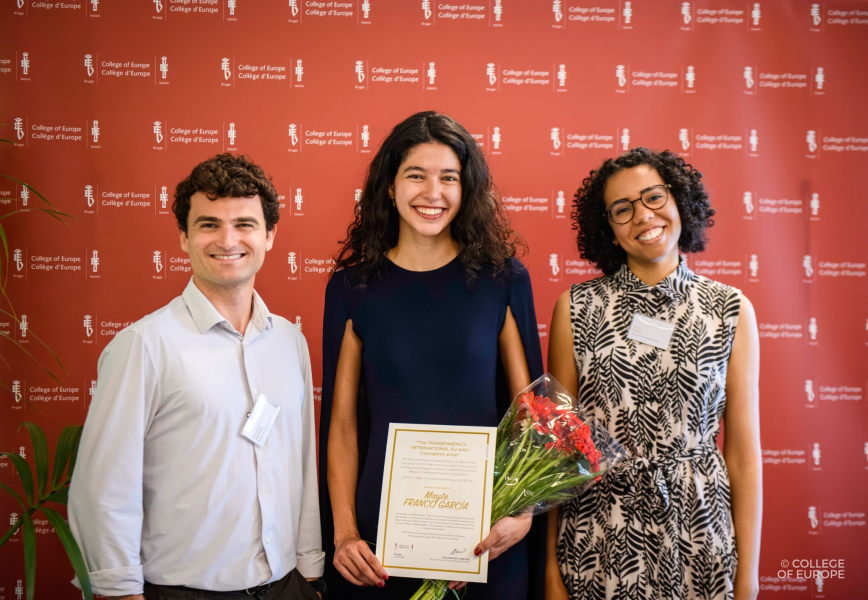
As has been tradition since 2016, Transparency International EU (TI EU) presents an annual award to a master’s graduate of the College of Europe, for the best thesis on the European Union’s role in fighting corruption, or the transparency, integrity, and accountability of EU institutions. After carefully reviewing the theses, 2026’s prize was awarded to European Political and Governance Studies graduate Mayte Franco García.
Mayte’s thesis, titled “The circle of LIFE: Manufactured attacks on civil society or genuine transparency concerns? Political contestation of NGO funding in the European Union”, examines what explains the shift from permissive consensus to sustained political contestation of LIFE operating grants to NGOs between 2022 and early 2026. These grants are awarded to fund ambitious projects aimed at halting biodiversity loss and restoring critical habitats. Since 2022, however, fierce criticism and budget cuts targeting LIFE grants have emerged from various quarters, on the highly dubious grounds that the European Commission is thereby funding organisations that go on to exert influence over that same policy. Mayte’s thesis reveals that this scrutiny was never genuinely accountability-driven, but was rather a politically motivated strategy targeting the advocacy capacity of environmental civil society organisations, dressed up in transparency language.
At Transparency International EU, we have been deeply engaged in combating the unfounded attacks on NGOs led by centre-right and far-right parties in the European Parliament. As part of this, we were among the frontrunners in successfully calling for a boycott of the Parliament’s Scrutiny Working Group on NGOs (SWG), set up by right-wing political groups to conduct a witch hunt against NGOs. Through this and via other initiatives, we aim to ensure that the European Parliament upholds its commitment to established democratic procedures and support for civil society. Mayte’s thesis sheds new light on this political assault, helping us understand what really motivates the (far) right’s so-far unsuccessful attempts to institutionalise attacks on civil society.
Mayte’s full thesis is available here.