

The data featured in this blog was sourced from Integrity Watch EU on April 27. The platform updates automatically on a daily basis and will feature higher numbers.
With over 17,000 registered organisations, Brussels is by far one of the most lobbied capitals in the world. With so many vying for the EU’s attention, the EU’s Transparency Register has become an essential tool to keep track of who is seeking to influence EU decision-makers, what interests they represent, and how many resources they devote to lobbying.
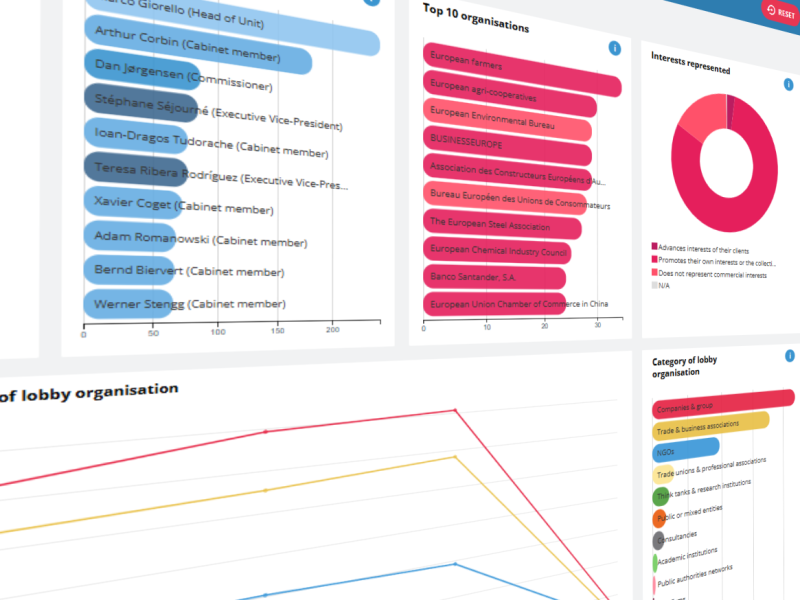
But a register is only as useful as the questions you can ask of it. That’s what led us to launch Integrity Watch EU, on our flagship online EU data-visualisation platform. For over 10 years, Integrity Watch has allowed citizens to browse all the transparency data the EU has made available, such as the meetings MEPs have been having, and the money they earn on the side. Today, we’re launching Integrity Watch’s new section on the lobbyists themselves. This organises the lobby data logged on the EU’s Transparency Register, allowing you to check who is accessing the corridors of power in Brussels and, crucially, the voices that are increasingly left out. Let’s dive into the data to explore what it reveals.
A rapidly growing register
Since the beginning of the current legislature in 2024, the register has been expanding at an unprecedented rate. For most of the past decade, new registrations would only reach the hundreds annually. In 2025, however, that figure surged to a whopping 4,112 organisations joining the register. This is largely due new transparency requirements at both the European Commission and Parliament, which make registration a precondition for certain types of engagement.1 While severe loopholes remain – especially one still allowing MEPs to meet with unregistered lobbyists – at the current rate of growth, the number of registrants is set to double by the end of this mandate. This rapid rise highlights how previous rules may have only covered the tip of the iceberg when it comes to lobbyist information.
Who are the lobbyists?
The EU’s Transparency Register is a sprawling register with 17,269 organisations spread across 140 countries. Companies and groups as well as trade and business associations form the single largest corporate block, at 47% of total registrants. This is followed by NGOs at 27%, succeeded by a long tail of smaller groups of interests including trade unions, think tanks, academic institutions, public authorities, and religious organisations.
Unsurprisingly, Belgium is the chosen location of most registrants, closely followed by France and Germany, two of the largest Member States in the EU. What is more surprising is that the United States and the United Kingdom are both home to more registered organisations than organisations based in 21 Member States. China is also a curious case, hosting a mere six registered organisations, lagging far behind the expected lobbying weight of the economic giant. In fact, non-EU organisations may actually be underrepresented: organisations are not required to state their headquarters as their country of origin, and may instead state the base of a subsidiary. According to the register, therefore, US tech giant Google is based in Ireland and Chinese EV company BYD states its location as the Netherlands, for example.
What everyone is lobbying about
Lobbyists are required to state their fields of interest from a pre-determined list. Here, the environment is the single most-cited policy area (54% of organisations), followed by research and innovation. Climate action (to the extent it is distinct from “environment” ranks third. Digital economy and energy round out the top five.
Commission access is the privilege of a minority
Since the commencement of Ursula von der Leyen’s second Commission in December 2024, there have been 27,523 logged lobby meetings. That is more meetings than the entirety of von der Leyen’s first mandate (2019 – 2024), once again reflecting the importance and relevance of the expanded transparency rules that were ushered in in December 2024, following pressure by us and our CSO partners. These measures made it mandatory for over 1400 Commission officials to only meet with registered lobbyists and publish meetings as well as the corresponding minutes. For the Parliament, post-Qatargate reforms made it mandatory for all MEPs and their assistants to publish, though they do not have the requirement to only meet with registered lobby organisations.
Among those that do get in the room, access clusters sharply at the top. Just 500 organisations account for nearly half (47%) of all meetings held during the current mandate. It is also worth noting that only 16% of these meetings involved NGOs – which is less than one in five – and this figure has remained constant throughout the mandate. This is also reflected in the top 100 organisations with access to the Commission, of which 84 organisations represent corporate interests.
What about the Parliament? With a total of 63,518 meetings since the beginning of the current mandate in June 2024, almost as many meetings have been logged those throughout the entirety of last mandate within less than two years, where it stood at 64,151 meetings in total. This large increase in logged meetings is due to the above-mentioned reform of transparency rules.
Yet while you can access MEP meetings through the Integrity Watch EU platform, MEPs do not always log these meetings using the organisation’s official transparency register name. For example, TI EU can be logged as “Transparency International liaison office to the EU” (our official name) but also as “Transparency EU” or “TI Europe”. This means that their meetings logs cannot consistently be cross-referenced with key information from the register such as categories of organisations, headquarter locations or resources available. Only slightly over half of MEPs engage in this best practice, making it exceedingly difficult to provide the same clear overview that is possible with the Commission.
Explore it yourself
These are just the patterns that have stood out to us. But don’t just take our word for it – explore the data yourself on Integrity Watch EU and browse tens of thousands of meetings, networks of organisations, see who is lobbying on which issues, and identify the big players in Brussels. Dive in, tell us what you find, and help hold power to account!